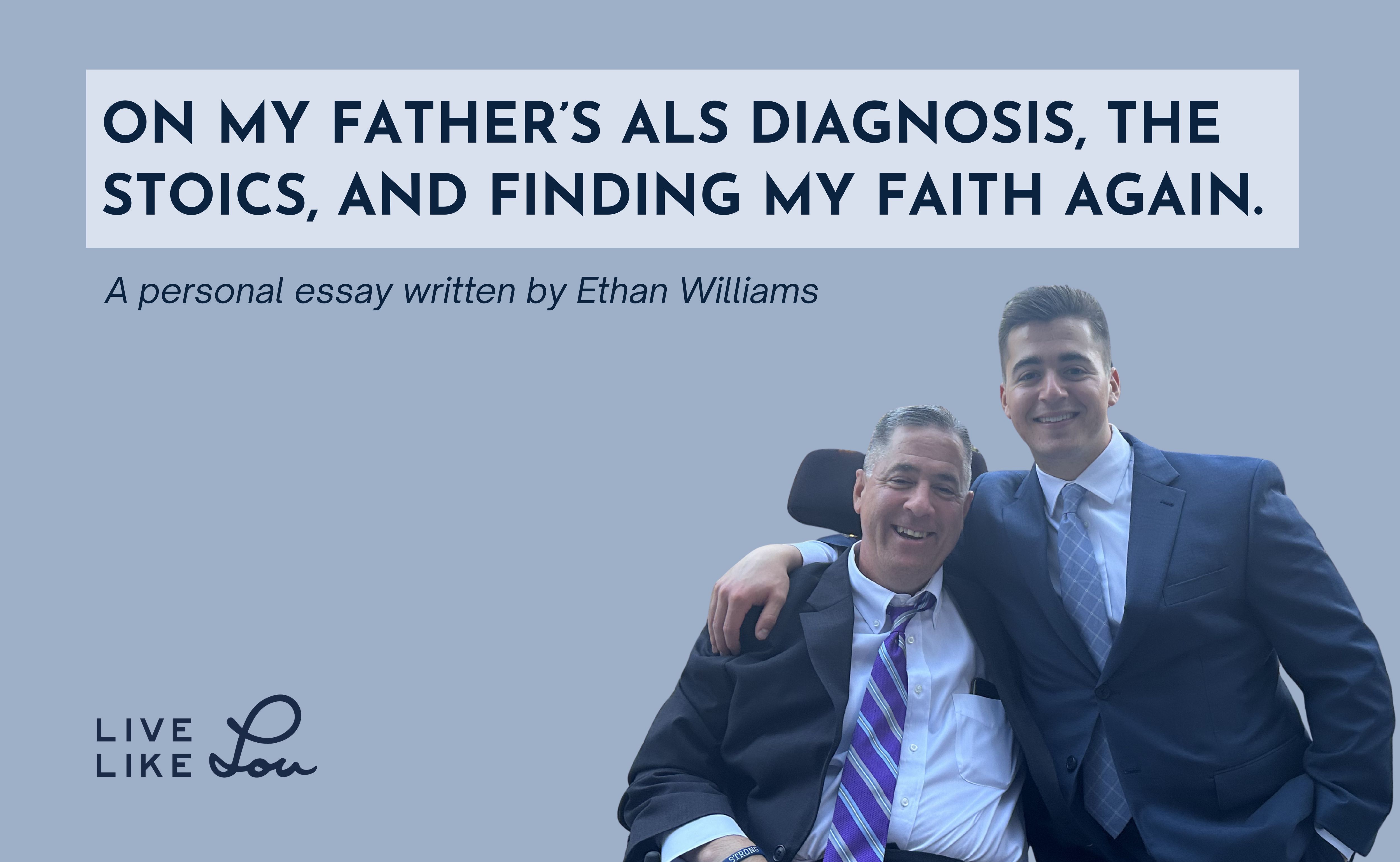
A personal essay written by Ethan Williams.
June 19, 2020.
Lou Gehrig’s birthday.
That was the day my dad was diagnosed with ALS.
You can’t write that sentence and not feel the cruelty in it. Lou Gehrig’s disease, handed to my father on the anniversary of the man’s birth. Of all the days on the calendar. The doctor probably did not know. He did not need to. We would learn soon enough.
Here is what I learned only later. June 19 was also the day Gehrig himself was diagnosed with ALS at the Mayo Clinic, on his thirty-sixth birthday, in 1939. Same calendar day. Same disease. Eighty-one years apart.
My dad wore the number 4 his whole life. It was on his football jersey when he was a boy in Mount Vernon, Ohio. It was always the number on his golf ball. He had 4 sons. Lou Gehrig wore the number 4. The disease that bears Gehrig’s name took my father’s body apart over 4 years. He died on October 9, 2024.

I want to talk about what got me through it. Because for a long time, nothing did.
The first months after the diagnosis, I was hollowed out. I lay awake at night turning the same thoughts over until the light came up. He is going to suffer. There is no cure. He is going to die, and there is nothing any of us can do. I would wake up and feel it land again. I went through the motions of daily life, of being a son, of being a brother to my three brothers, but inside I was somewhere far away, watching my own life happen from a distance.
I tried to distract myself. I tried to look away. For a while, the only honest emotion I could find was anger, so I sat in that.
Then I picked up a book.
It was Ryan Holiday’s Discipline is Destiny. I cannot remember where I came across it. I had just graduated from the United States Naval Academy and was suddenly responsible for Sailors of my own, and I was reading anything I could find on discipline, leadership, and what it actually took to lead others well. I ordered a copy and started turning pages.
A few chapters in, Holiday began telling a story. About a baseball player. About a man whose body was betraying him in front of more than sixty thousand people. About the speech he gave at Yankee Stadium on July 4, 1939, leaning into a microphone with his teammates lined up behind him, telling the world he considered himself the luckiest man on the face of the earth.
Lou Gehrig.
I had to put the book down. I sat there and held it. The man whose name I had only ever associated with the day my dad was diagnosed and with the disease that colloquially bears his name. The man whose number my dad had worn his whole life. The man whose disease was killing him. And here he was, in a book about Stoic philosophy, presented as a model of discipline.
I do not know what to call that. I am not the kind of person who chases signs. But I know one when it shows up.
(Holiday, by the way, is an excellent gateway. If you have never read a page of philosophy in your life, start with him. Courage is Calling. The Obstacle is the Way. Ego is the Enemy. Discipline is Destiny. He has taken two thousand years of dense, often difficult Stoic writing and rendered it into something anyone can actually use. That is a real service. He led me to the source material, which is what good modern teachers do.)
After Holiday, I went deep into the Stoics.
Seneca first, because his letters read like something a man would write to a friend over a glass of wine. Then Epictetus, the slave turned philosopher who had nothing and somehow had everything. Then the founders, men I had heard nothing of in any economics or engineering class I had taken. Zeno of Citium, the merchant who lost his fortune in a shipwreck and stumbled into philosophy at an Athenian bookseller’s shop. Cleanthes the water-carrier, who supported his studies by hauling water at night. Chrysippus, who systematized the school. Musonius Rufus, the Roman who believed philosophy was something you did, not something you read. Cato the Younger, whom Seneca held up as the model of the wise man and who chose to fall on his own sword rather than live under tyranny. Diogenes the Cynic, who shaped them all.
And then Marcus Aurelius.
I read Meditations front to back in one sitting. I want to say that carefully, because I do not say it for effect. I sat down with that book on a Saturday afternoon, and I did not get up until I had finished it.
You have to understand what Meditations is. It was never meant to be a book. It is the private journal of a Roman emperor, written to himself during some of the worst years of his reign, while his wife Faustina was dying, while the Antonine Plague was killing his soldiers by the thousands, while he was leading an empire he never asked to lead. He never intended for anyone to read it. He was simply trying to keep his bearings. He was not trying to teach. He was surviving, and writing it down as he went.
A few of the lines I underlined that afternoon and have come back to over and over:
“If you are distressed by anything external, the pain is not due to the thing itself, but to your estimate of it; and this you have the power to revoke at any moment.”
“The impediment to action advances action. What stands in the way becomes the way.”
“Waste no more time arguing what a good man should be. Be one.”
“Confine thyself to the present.”
“Begin the morning by saying to thyself, I shall meet with the busybody, the ungrateful, arrogant, deceitful, envious, unsocial. All these things happen to them by reason of their ignorance of what is good and evil.”
"At dawn, when you have trouble getting out of bed, tell yourself: I have to go to work, as a human being. What do I have to complain of, if I'm going to do what I was born for, the things I was brought into the world to do? Or is this what I was created for? To huddle under the blankets and stay warm?"
I read those during a time when my dad was beginning to visibly struggle. When he could no longer rise from a chair without help. When my mom was learning how to operate the equipment that kept him breathing through the night. You read words like that, in a context like that, and they mean something different than they would have meant before. I read at least a few pages of Meditations every morning now. Sometimes a paragraph. Sometimes a single sentence. I keep one copy in my office, one by my bed, and one on my Kindle.
If you do nothing else after reading this essay, do that. Get a copy. Read a page a day. You do not have to be a philosophy person. You do not have to be religious. You do not have to be in pain. Just read it.
The Stoics gave me 4 ideas that held me up when nothing else could. And it has to be 4, because that is the number that holds my family up.
The first is the dichotomy of control. There are things up to you and things not up to you. Epictetus opens his entire Enchiridion with this. Whether my father lived or died was not up to me. How I showed up for him was. That distinction sounds simple, but it took me a year of suffering to actually feel it in my body.
The second is amor fati, the love of fate. Do not just accept what happens to you. Love it. Want it. Even the suffering. I am not there and I do not know if I will ever fully be there. But the direction matters more than the destination.
The third is memento mori. Remember you will die. The Stoics did not run from death. They put a skull on the desk. They wrote about it every morning. The point is not morbidity. The point is that death is the thing that gives life its weight. Once you start sitting with it daily, the smaller problems shrink to their actual size.
The fourth is the 4 cardinal virtues. The Stoics named them Wisdom, Courage, Justice, and Temperance. The whole project, distilled down to 4 words. And of course it would be 4. Of course it would.
Here is something I did not expect. Reading the Stoics lit my Catholic faith back up.
I was raised Catholic. I drifted in college, the way many drift, not in any dramatic way, just slowly and quietly, until I realized I had not been to Mass in months. The Stoics pointed me right back. The more I read Marcus, the more I saw Christ. The more I read Epictetus, the more I saw the Holy Spirit. There is a reason Augustine wrestled with the Stoics throughout The City of God, drawing from them and arguing against them in equal measure. There is a reason Thomas Aquinas folded the 4 cardinal virtues into Catholic moral theology. The Catholic Church renamed the Stoic 4 slightly: Prudence, Justice, Fortitude, and Temperance. The Catechism teaches them today as the natural virtues that grace builds on. They came to us through Plato, through Aristotle, through the Stoics, through the Book of Wisdom, before they came to us through Aquinas. Same virtues. Different name in each century.
The Stoics taught me that suffering is not a problem to solve. It is a condition to inhabit. The Catholic faith taught me what to do with it once you are in it. That my dad’s 4 years of suffering were not random. That they were joined to a cross. That suffering offered up is not wasted, even when no human eye can see what it accomplished.
There is a phrase Catholics use that you only really understand once you are inside the thing: offering it up. You take whatever you are carrying. The pain. The dread. The small daily humiliations of watching your father lose his body. And you hand it to Christ to be joined to His Passion. It is not pretending the suffering does not hurt. It is not Stoic detachment. It is the opposite. You feel the full weight of it, you do not look away, and you give it as a gift. John Paul II wrote an entire apostolic letter on this, Salvifici Doloris, on the Christian meaning of suffering. By the end of his life, his body had been destroyed by Parkinson’s. He was not theorizing.
I started praying the Rosary again. The Sorrowful Mysteries are five meditations on Christ’s Passion. The agony in the garden. The scourging at the pillar. The crowning with thorns. The carrying of the cross. The crucifixion. I pray them and I begin to see my father in them. I also begin to see Mary. (Which, by the way, is my mother's name.) Watching her own son die. She is the patron of every mother who has watched her son go before her. She is also, by extension, the patron of every son who has stood by a hospital bed.
The Eucharist anchored me through the worst of it. The Catholic doctrine is that the Eucharist is the Real Presence of Christ, body and blood, soul and divinity. You can argue with that doctrine, and many smart people do, but I will say only what I know. Walking up the aisle and receiving communion during the toughest moments of my dad’s fight was the only time in any given week when my chest unclenched. I cannot explain that, and I will not try.
The lines from my faith hit me the way Marcus did, only deeper:
“Be not afraid.” Said by Christ in the Gospels again and again. Said by John Paul II in 1978 at the start of his pontificate, the words that came to define his entire papacy. Said by an angel to a frightened girl in Nazareth.
“Pray, hope, and don’t worry.” Padre Pio.
“Our hearts are restless until they rest in You.” Augustine, Confessions.
“I can do all things through Him who strengthens me.” Paul, to the Philippians.
“The Lord is my shepherd; I shall not want.”
“Have I not commanded you? Be strong and courageous. Do not be afraid; do not be discouraged, for the Lord your God will be with you wherever you go.” Joshua 1:9.
The thing I missed in college, the thing I did not understand, is that the Catholic faith is not a feeling. It is a structure. It is an inheritance. It is one of the longest continuous institutions in the West, and it has held men together through plagues and wars and famines and the deaths of their fathers. It was built for moments like the one I was in.
I am back at Mass, and I am praying often. I am reading the 4 Gospels. My faith is the strongest source of moral courage I have, and I expect it to remain so for the rest of my life.
The other place I find my dad is the golf course.
We played together my whole life. He taught me the game. He was the one who insisted on using only golf balls with the number 4. The last time we played was Thanksgiving 2022, when I was home on leave. He could no longer carry his bag. He used a handicap cart that lets you stand upright at address. He still hit it pure.
The course is the only place in my life where my mind goes fully quiet. I turn my phone off when I tee off. I leave it off until I shake hands on 18. For 4 hours, the only inputs I get are the wind, the grass, my own breath, and whatever I happen to be thinking. No notifications. No news. No noise.
I cannot say strongly enough how much every person should do something like this. Pick the 4 hours. Turn the phone off. Be in your body. Look at the trees. Listen to the wind. The Stoics did this naturally because they did not have phones. We have to do it on purpose now, against the grain of every product designed to keep us from doing it. It is one of the most countercultural things a man can do in 2026.

I get paired up with strangers all the time. Most of the time I never get a last name. We talk about the course. About the weather. About the Browns or the Buckeyes, if my fandom tips them off. Sometimes about something real. I love it because it is one of the last places left in American life where you can talk to a stranger without an agenda. No one is selling anything. No one is trying to capture your attention. You are just two people walking the same way for 4 hours.
That is where I think clearest. Where I write entire essays in my head before I get back to the car. Where my best ideas show up. And it is where my dad shows up. I will line up a putt and hear him. Be aggressive. Trust the line. It’s only a putt. I will find a 4 ball in my pocket and proudly smile up to the sky. He is there with me. I know it.
I am writing this because I know I am not the only person who has been affected by ALS, or by any kind of suffering. I know I am not the only one trying to figure out how to stand up under that weight. And I know, looking around at the world right now, that a lot of us are afraid. Of what is coming. Of what we cannot control. Of how thin the ground feels under our feet.
The Stoics and the Catholic Church have been holding people up for two thousand years. They held me up when nothing else could. I owe it to my dad, and to the man he raised me to be, to say so out loud.
If you are scared, read Marcus. Read Seneca’s letters. Pray. Sit in a pew. Sit in silence. Walk a fairway. Be still long enough to hear what is actually there.
You have less control than you think. You have more strength than you know. The number you would pick to hold you up is probably already in your life, sitting there, waiting for you to notice it.
For us, it was 4.
For my dad, who ordered his golf balls with a 4 his whole life. Who wore it on his back. Who fought 4 years. Who raised 4 boys. Whom I will see again.
Requiescat in pace.